
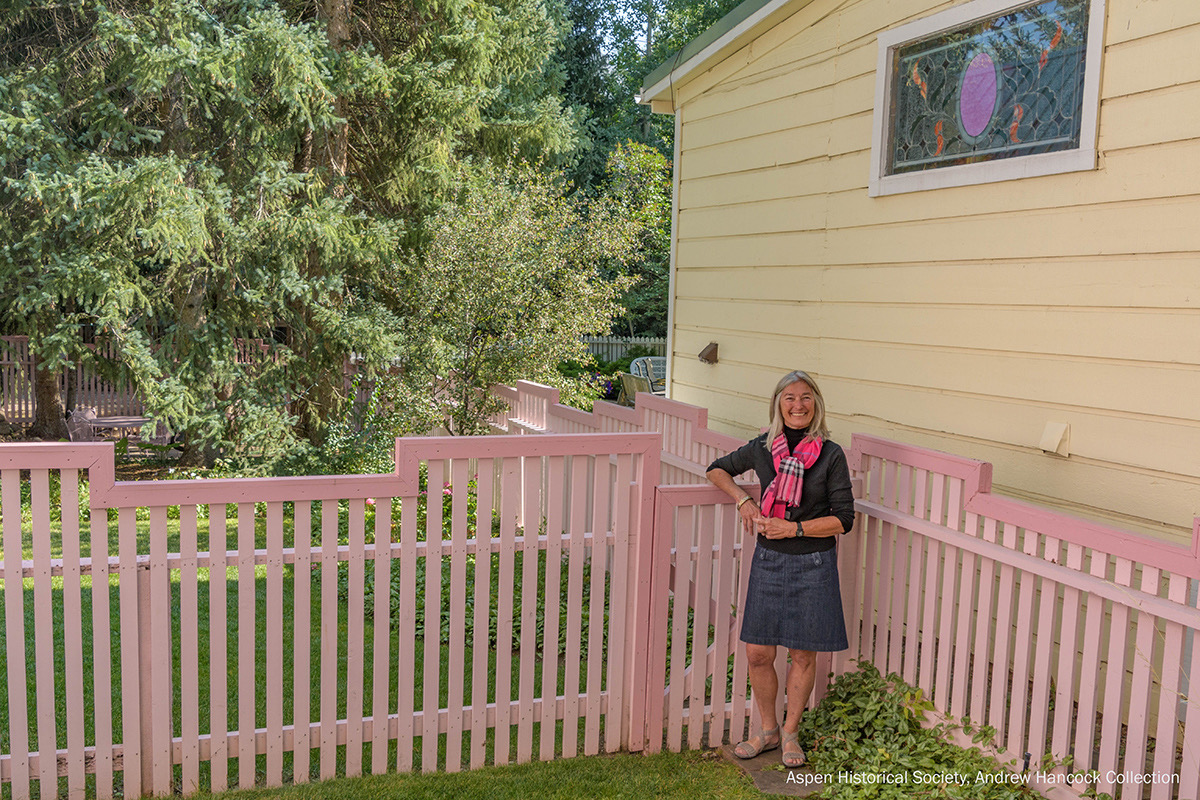
This charming Victorian home, located at 216 W. Hyman Street, includes a recently restored fence, painted a vibrant pink. Credit: Aspen Historical Society
The Modern Picket
A walk through Aspen’s residential neighborhoods reveals proof of Herbert Bayer’s design incorporating the total environment.
By Sarah Shaw
In Aspen, Herbert Bayer’s name is most often associated with the design of historic buildings (the original Sundeck on Aspen Mountain, for example), the Aspen Meadows campus, and the original visual identity of the Aspen Skiing Company. While those flashy statements served him well during his early years in Aspen, his belief in the Bauhaus concept of a Gesamtkunstwerk (a total work of art or total aesthetic) prompted him to devote equal attention to the design of mundane elements–like fences.
When Bayer arrived in Aspen in 1946, he found a graveyard of abandoned Victorian homes and miners’ cottages, their windows boarded up or missing, their roofs caved in. Some fences, however, were still intact, their varied design a sign of the distinct social politics that existed at the height of Aspen’s Silver Boom. In Aspen’s West End, historically home to the city’s wealthiest residents, property lines were defined by elegant, decorative iron or wooden picket fences whose purpose was to provide a backdrop to manicured lawns, flower beds, and flamboyant Victorian architecture.
A new fence design by Herbert Bayer offered a unified, modern appearance that would bridge the gap between the city’s historic mining-era buildings with the clean geometric lines of a modern architectural style. The “Bayer fence” consisted of evenly spaced pickets crenellated with alternating upright sections and lower indentations, much like a castle rampart. It was also a piece of art visible from the public right-of-way, and a demonstration of his commitment to reconciling old and new in a way that emphasized his belief in creating “a total work of art.”
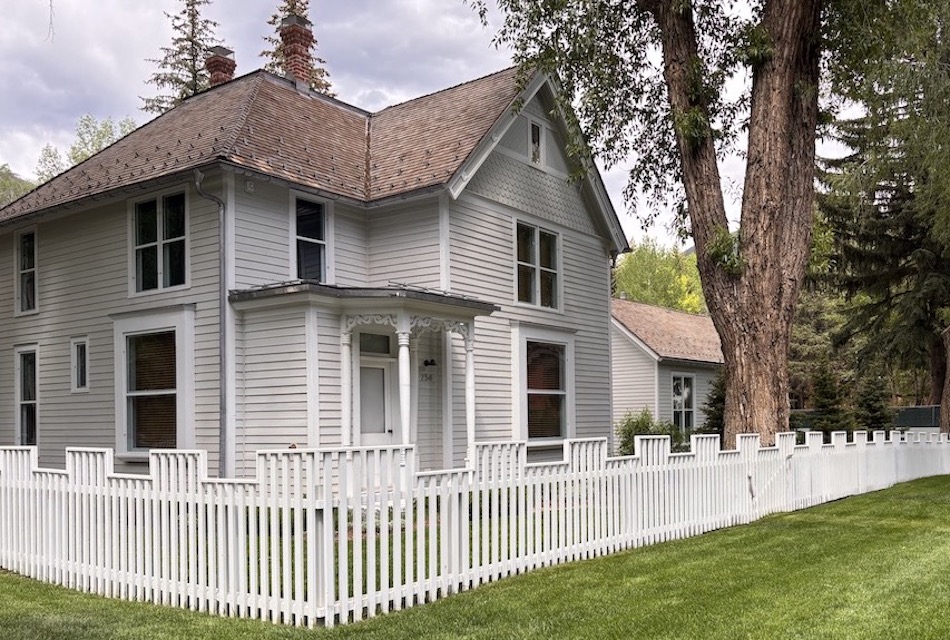
This Late Victorian–style home, located at 234 West Francis Street, was constructed in 1888. It was occupied by Davis H. Waite before and after his two-year term as Colorado’s governor. Herbert Bayer made it his very first residence when he moved to Aspen, framing it with his signature fence. Photo credit: Sarah Shaw
Many of Bayer’s original fences have been lost to redevelopment over the decades; however, a few can still be found throughout town.
• 234 West Francis Street: This Late Victorian–style, two-story home, constructed in 1888, was occupied by Davis H. Waite before and after his two-year term as Colorado’s governor. Herbert Bayer made it his very first residence when he moved to Aspen, framing it with his signature fence, (see image above).
• 216 West Hyman Street: This charming Victorian home includes a recently restored fence, appropriately painted a vibrant pink, (see image above).
• Aspen’s Historic West End: Many variations of these geometric, alternating-height picket fences can be seen in private historic yards.
Sarah Shaw is the Bayer Center’s Communications Manager.