
‘The ideal’ versus ‘the real’
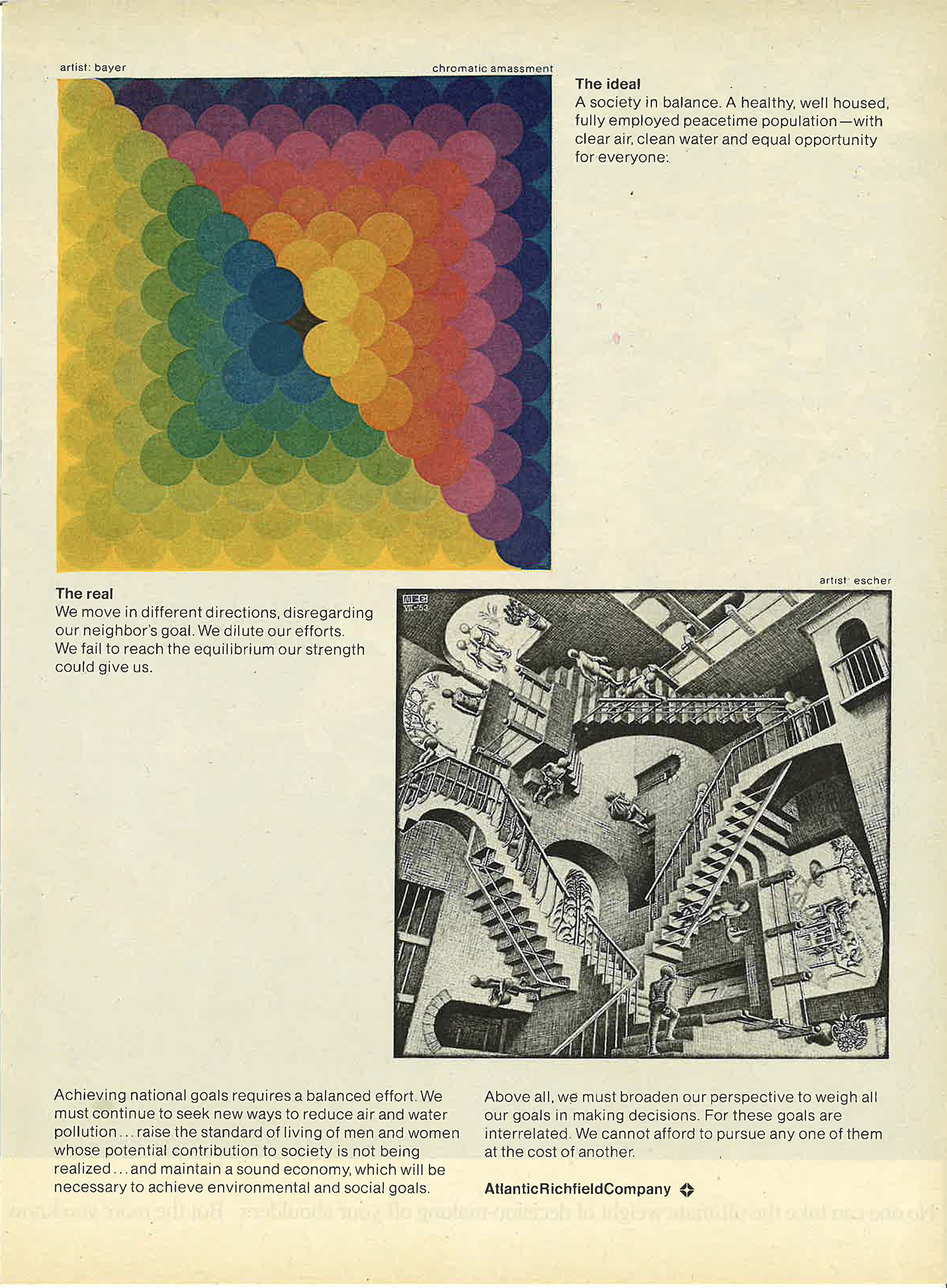
In an early 1970s magazine advertising campaign, the Atlantic Richfield Company (ARCO) utilized a Herbert Bayer “chromatic” painting as a vision for “a society in balance.”
The advertisement, which juxtaposes Bayer’s work with an M. C. Escher lithograph, recently came to the attention of the Bayer Center as part of a gift of Bayer-related material from Peter Waanders, CEO of Anderson Ranch Arts Center and a Bayer collector.
Pictured above, the ad features Bayer’s 1971 acrylic painting Chromatic Amassment as representing “the ideal”: “a society in balance; a healthy, well-housed, fully employed peacetime population—with clear air, clean water, and equal opportunity for everyone.”
It is contrasted with Escher’s well-known and surreal Relativity (1953), representing “the real”: “We move in different directions, disregarding our neighbor’s goals. We dilute our efforts. We fail to reach the equilibrium our strength could give us.”
The ad concludes:
Achieving national goals requires balanced effort. We must continue to seek new ways to reduce air and water pollution . . . raise the standard of living of men and women whose potential contribution to society is not being realized . . . and maintain a sound economy, which will be necessary to achieve environmental and social goals. Above all, we must broaden our perspective to weigh all our goals in making decisions. For these goals are interrelated. We cannot afford to pursue any of them at the cost of another.
Only at the bottom of the ad is the oil and gas company named in bold, with its Bayer-designed logo beside it.
Bayer had been head of design for Atlantic Richfield since 1966. Its CEO, Robert O. Anderson, served as president of the Aspen Institute from 1957 to 1963 and chairman of the board from 1963 to 1987. He also succeeded Walter Paepcke as Herbert Bayer’s primary patron.
more