Photo courtesy of Koko Bayer
Mill Creek Canyon Earthworks Park
A Modernist Masterpiece of Urban Infrastructure
By Sarah Shaw
“A dam in the ordinary sense constitutes a radical interference with the natural configuration of the land. My intent was, therefore, to give the dams a natural appearance conforming to the landscape.”
— Herbert Bayer, King County Arts Commission Newsletter, August 1982
In December 2025, a multi-day atmospheric river event struck the city of Kent and western Washington with torrential rain and flooding. While levees along the Green River overflowed, Herbert Bayer’s Mill Creek Canyon Earthworks Park-highlighted in our 2025–26 exhibition, Sculpting the Environment–performed exactly as intended. The park protected the local community from severe damage by capturing and managing the surge of excess water.
History of the Park
Purchased by the City of Kent in the late 1960s, Mill Creek Canyon Earthworks Park is a 104-acre natural resource area characterized by a steep, forested canyon and bisected by Mill Creek. Subsequent adjacent development on the bluffs above the site created significant stormwater issues in the creek, resulting in the construction of a water-detention dam. A decade later, development had exceeded capacity and catch basins and stream-flow controls were needed to manage stormwater. What had once been envisioned as a beautiful public facility was now a major utility project.
In 1979, the King County Arts Commission (one of the first county arts agencies in the country) invited eight internationally-acclaimed artists to participate in a symposium titled Earthworks: Land Reclamation as Sculpture. At the symposium, artists were tasked with reimagining the county’s post-industrial sites—gravel pits, surface mines, landfill sites, and other environmentally damaged lands—as artistic solutions for environmental recovery. After learning of King County Arts’ upcoming symposium, Kent’s mayor requested that the county’s artist-selection panel find an artist to help design a functional stormwater retention dam for Mill Creek Canyon Park that would provide an artful solution for flood mitigation.
Herbert Bayer’s Design
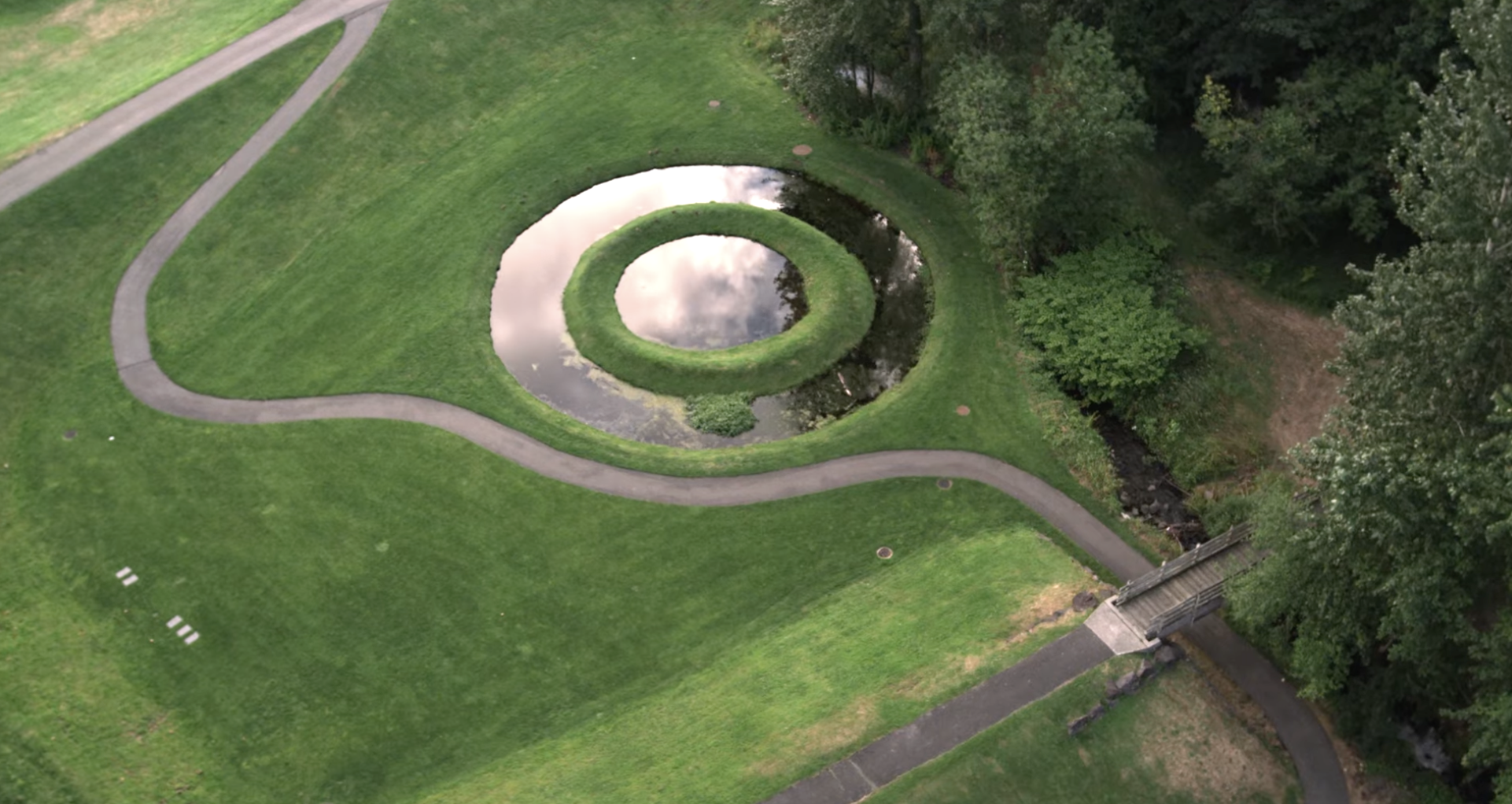
While not an official participant in the 1979 King County symposium, Herbert Bayer was invited to display his drawings and models for Mill Creek Canyon Earthworks Park. A Bauhaus master, Bayer embraced the movement’s core principle of form following function, where purpose was elevated by high-level design. For the park, Bayer proposed a series of pure forms—sculpted cones, circles, lines, and berms—to fill the two-and-a-half-acre flat alluvial delta of Mill Creek Canyon. Grass-covered mounds ranging between 40 and 100 feet in diameter would rest on top of a stormwater detention facility, while sinuous pathways would carve through expanses of lawn, tracing the mounds’ curvilinear outlines. Special elements like a double-ring pond would provide visual interest during water level fluctuations. The community loved it. Built in 1982, it was a groundbreaking piece of landscape architecture and engineering that provided a solution to a regional problem.
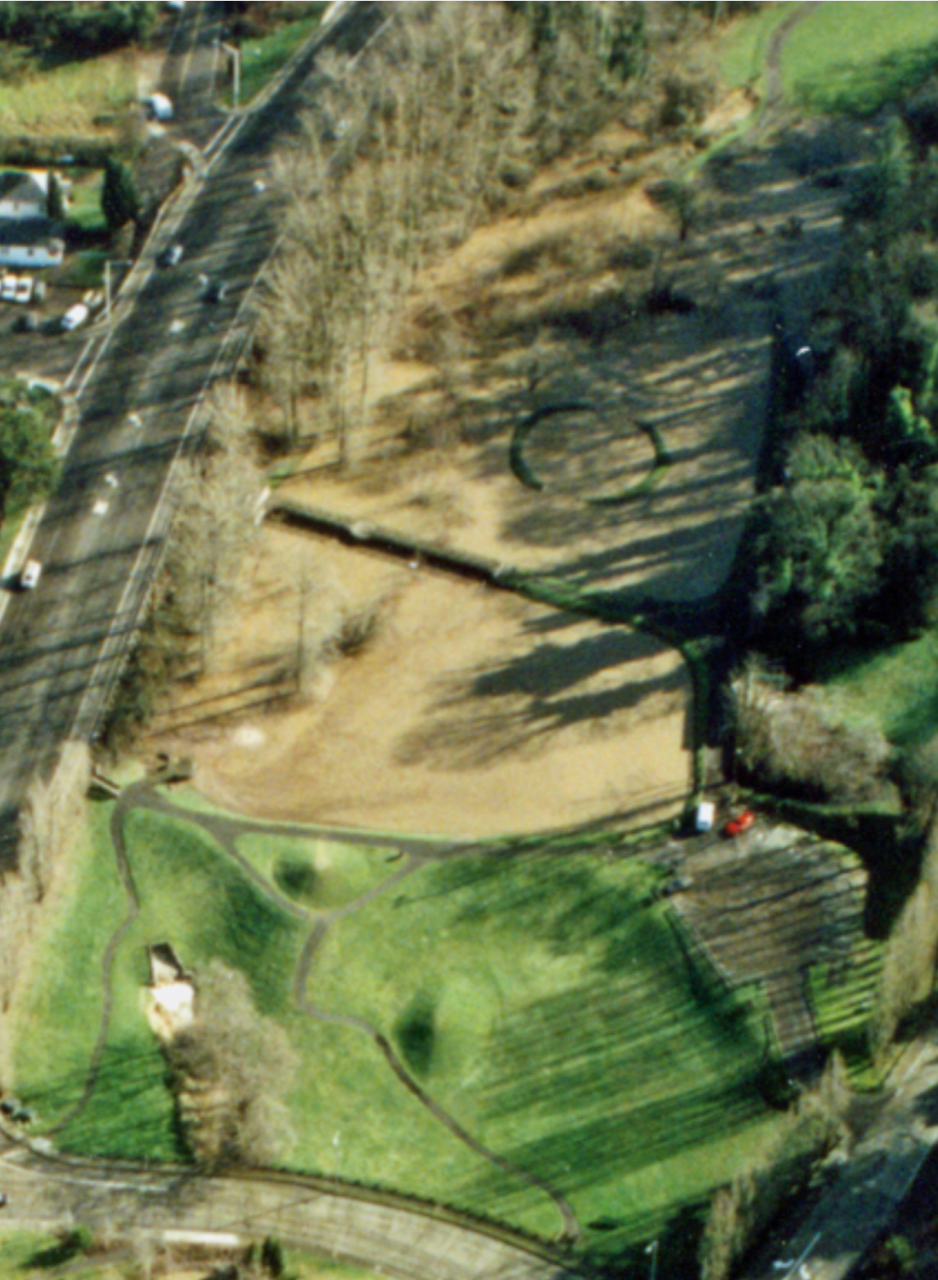
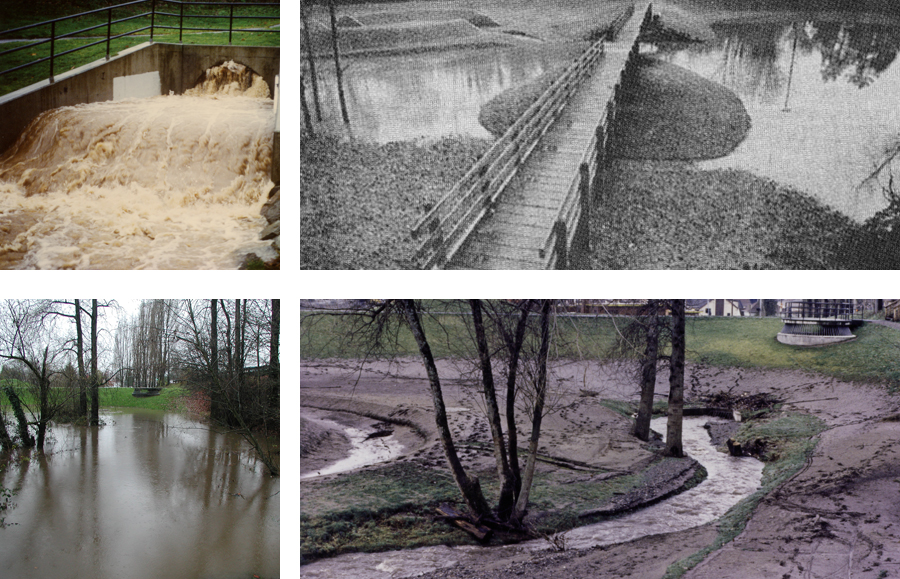
These photos, both courtesy of the City of Kent, illustrate the effectiveness of Bayer’s design during a flood event. In the image on the left, the dam is effectively controlling the deluge of water flooding through the park. The internal ring of the double-ring pond is barely visible above the water’s surface.
Forty-Five Years Later
Originally designed to withstand a 100-year storm, Bayer’s dam was raised approximately two feet in 2008 to conform with the state’s mandate that it meet a 10,000-year flood event. During the floods of late 2025, impact reports recorded the spillway’s effective management and controlled release of water into the city’s storm system. Observers noted that the double-ring pond was completely submerged during the surge—a phenomenon Bayer described as “revealing the process.” As the basins filled, the mounds slowly disappeared, visually demonstrating the scale of the flood. Combining pragmatism with environmental visualization, Bayer’s masterwork proved as resilient as it is beautiful.
Sarah Shaw is the Bayer Center’s Communications Manager.
more