

‘Window by the Desk’, (1944), is currently on view in the Bayer Center’s exhibition, ‘Double Take: Recurrent Dialogues in the Art of Herbert Bayer.’ Courtesy of the Collection of Lynda and Stewart Resnick
Exhibition spotlight: “Window by the Desk”
Framing devices offer an intimate view of Herbert Bayer's creative space
By Sarah Shaw
In the Bayer Center’s current exhibition, Double Take: Recurrent Dialogues in the Art of Herbert Bayer, Bayer’s creative process is revealed through his practice of reusing and rearranging iconographic elements in a myriad of ways throughout his career as a visual artist. The exhibition explores six motifs, including frames—defined as a four-sided shape with a void center and articulated by Bayer in three ways: actual picture frames, cobbled-together frame-like shapes, and window frames. Framing devices fascinated Bayer, and he employed them as a method for providing unity and order in his work.
In his ambitious and abstracted Window by the Desk (1944), a series of frames form the setting for a desk situated in a bay with four windows providing a view of his garden. Botanical images (their curvilinear patterns looking more like onion slices than flattened leaves) appear on the desk and on the easel. Vertical lines, suggesting a wood floor, and long shadows depicted in deep blue, provide depth to the painting’s lower half while above, interior details appear juxtaposed–a candle and other elements–with the permeable boundaries of an exterior architectural space. A diagonal shaft of pure yellow emanates from an unknown source in the upper right, while leaves blow haphazardly through a window to the left. A single cord anchored by an eye hook suggests that the window shade has just been opened to reveal the scene outside the window.
The painting’s bold primary colors and heavy black outlines point to the influence of modernists Fernand Léger and Piet Mondrian on Bayer’s work. In fact, the three were part of a circle of fellow emigrés that included Alexander Calder and other modernists living in New York during World War II. Bayer had been living in Manhattan since 1938, and had started spending parts of his summers at a home on Long Island. His studio there included the titular window and desk depicted in this extraordinary painting.
In his book, The Way Beyond ‘Art’, art historian Alexander Dorner describes the circumstances surrounding the painting’s creation, suggesting that Bayer wanted viewers of the painting to form their own distinct visual perception of his studio space. Dorner writes: “Sitting at this desk in his summer home on Long Island, and looking through the windows, he sees that sunbeams and shadows, clouds and leaves interact with things on his desk. The outside world enters the inside of the house, as it does in the modern architect’s imagination and design.”
Bayer produced six preparatory variations of Window by the Desk, four in watercolor and two in oil, prior to painting the final version. In each, he focused on natural elements, highlighting wind conditions, cloud formations, and the changing patterns of sunlight. This type of visual vocabulary became more prevalent in later works, such as the World Geo-Graphic Atlas (1953) and his Anthology series (1976-1983).
Nowhere is proof of Bayer’s lifelong interest in framing devices more poignant than in Puchenau, painted in 1919 when he was just 19 years old. Displayed next to Window by the Desk in the “Frame” gallery of Double Take, it is one of Bayer’s earliest known watercolors. In it, a window opens onto a distant view of mountains with a river in the foreground. It does not include the cubist and abstract touches included in Window by the Desk. The style and the subject appear similar to the German Romantic painter Caspar David Friedrich’s View from the Artists’s Studio, Right Window, c. 1805-06, a piece credited with introducing the open window motif in Romantic art.

Herbert Bayer, 'Puchenau,' 1919/2. Watercolor and pencil on paper. Denver Art Museum, Gift of the Estate of Joella Bayer, 2004.
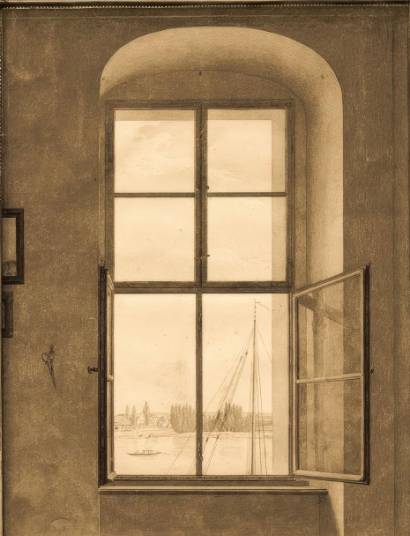
Caspar David Friedrich, 'View from the Artist's Studio, Right Window,' c. 1805-06. Sepia and graphite on paper. Belvedere Museum, Vienna.
Window by the Desk: The Paepckes’ Pick
In 1947, Walter and Elizabeth Paepcke submitted Window by the Desk to the Seventh Annual Society for Contemporary American Art Exhibition. It was listed for $800. The Society for Contemporary Art (now known as the Society for Contemporary Art at the Art Institute of Chicago), founded in 1940, consisted of a handpicked group of progressive and wealthy mid-century art collectors and patrons. Theirs was a very simple mission: purchase cutting-edge, modern American art to donate to the Art Institute’s permanent collection.
Each member couple of the society was required to find and nominate an exceptional contemporary artwork of their choice. Membership dues and society fundraising events paid for the work, moving it directly from the show to the museum’s walls with little to no cost to the Art Institute.
While, historically, members of the Society took extraordinary risks on artists long before they became household names, it is no surprise that the Paepckes chose this opportunity to introduce Herbert Bayer to the Chicago art world. In 1946, one year prior to the submission of the painting to the Society, Bayer and his wife, Joella, had relocated to Aspen at the invitation of the Paepckes to lead the design of the Aspen Institute.
The Society ultimately purchased Virgil Clavier (1946), an oil painting by Walter Murch, an artist and freelance commercial illustrator whose work, much like Bayer’s, was highly sought after by industrial corporations. The Society also purchased The Fringe on Your Panties (1946), a mobile sculpture by Alexander Calder. Bayer’s work was rejected in good company: other emerging modernist artists, such as Arthur Dove, Harry Bertoia, and Josef Albers, were passed over as well. The inclusion of Window by the Desk highlights a point in time when the Bauhaus aesthetic transitioned into mainstream American institutions through the work and influence of powerful mid-century corporate and cultural patrons.
Sarah Shaw is the Bayer Center’s Communications Manager.